
How Sound Therapy Can Help You Feel More Calm, Grounded and Present


With so many demands competing for our attention, it is easy to spend much of our day focused on what has already happened or what needs to happen next.
We may replay conversations from the past, plan for future responsibilities or become caught up in the endless list of things we need to do. While this is a natural part of being human, constantly living in our thoughts can make it difficult to experience the present moment.
Sound therapy and sound bath meditation offer a gentle opportunity to practise coming back to the here and now. If you are new to this practice, you may like to begin with my article on The Benefits of Sound Th erapy for Mind and Body: A Guide to Relaxation and Wellbeing, and explore related posts on How Sound Baths Can Support Relaxation and Recovery After a Busy Week through grounding and relaxation for a broader understanding of how these practices can support wellbeing.
How Sound Therapy Can Help You Feel More Calm, Grounded and Present
OVERVIEW:
Supporting a calmer state

When we intentionally slow down, breathe and focus our attention, we give ourselves an opportunity to shift away from the constant activity of everyday life.
The combination of guided meditation, mindful awareness and soothing sounds can support a sense of calm and relaxation. By creating a dedicated time to pause, we allow the body and mind to move away from a state of constant alertness and towards a more restful state.
This does not mean that thoughts disappear or that life’s challenges go away. Instead, it creates a space where we can practise responding with greater awareness rather than automatically reacting.
Using sound as an anchor for presence
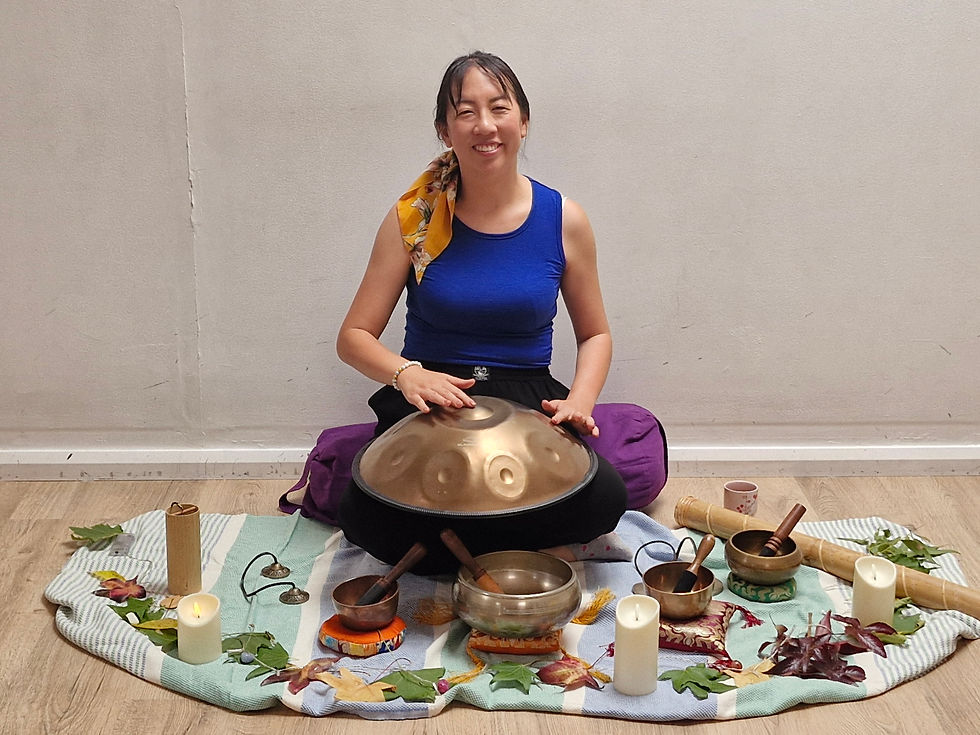
Sound can be a powerful anchor for mindfulness because it naturally brings our attention into the present.
As you listen to the tones, vibrations and changing instruments, there is always something new to notice. When your eyes are closed and you are simply listening, the shift from one sound to another can keep you gently curious. Not knowing what will come next can help pique interest and draw your attention back to the moment.
This is one of the reasons sound bath meditation can feel so immersive. The sounds are not static. They move, evolve and unfold, inviting you to stay engaged without effort. In this way, sound becomes something to rest your attention on, much like the breath in other forms of meditation.
Why stillness and closed eyes can deepen awareness

In most sound bath meditations, we lie down or sit comfortably with our eyes closed and the body still. This inactivity is intentional.
When we remove the usual demands of movement and reduce visual input, other senses often become more noticeable. You may become more aware of the sound itself, the feeling of your body resting, the rhythm of your breath or subtle sensations that are usually overlooked.
This shift can support surrender. Rather than trying to manage or analyse the experience, you are invited to receive it. With less external stimulation, there is often greater awareness of being in the moment.
Sometimes this can even create space for deeper insight into both body and mind.
The practice of coming back

Meditation is not about having a perfectly quiet mind. Even experienced meditators have thoughts arise.
The practice is noticing when your attention has wandered and gently guiding yourself back — back to the sound, back to your breath, back to the present moment.
Each time you return, you strengthen your ability to cultivate awareness and presence.
Over time, creating regular moments of mindfulness can help you develop a greater connection with yourself — your thoughts, emotions and physical sensations — allowing you to move through life with more calm, clarity and intention.
Insights that can arise during a sound bath

Many people are surprised by what they notice once they settle into the practice. Some students have shared that they did not realise how tight their shoulders were until they softened into the sounds. Others notice how tired they actually are, or how much they have been holding in their body and mind.
At times, the insights are more subtle. You may become aware of a thought pattern, an emotion you have been carrying or a decision that needs attention. These moments are not forced; they often arise because the body is quiet enough for the mind to speak more clearly.
This is one of the reasons sound bath meditation can be so supportive. It creates a calm environment where awareness can deepen without pressure.
👉 Enter your details to access a FREE Grounding Meditation
This guided meditation is designed to help you:
slow down mentally
reconnect with your body
release tension and stress
create a sense of calm and presence
Creating moments of presence in everyday life

A sound bath is not about escaping life; it is about creating space to reconnect with yourself within life.
By taking time to pause, listen and be present, you can develop a greater awareness of your own needs and create moments of calm that support your overall wellbeing.
If you would like to explore this further, you may also enjoy my related posts on How Sound Baths Can Support Relaxation and Recovery After a Busy Week, as well as my post on Beginner’s Experience — What Happens in a Sound Bath Session? for a fuller introduction to the practice.
Final THOUGHTS

In this article, we explored "How Sound Therapy Can Help You Feel More Calm, Grounded and Present." Sound therapy and sound bath meditation are not about forcing the mind to be still or trying to block out every thought. They are about creating a gentle container where sound, stillness and awareness can help you return to yourself.
When you allow the sounds to anchor your attention, close your eyes and rest in stillness, you may find that presence becomes easier to access — and with it, calm, clarity and insight.
If you would like to practise this at home, enter your details to download my free grounding meditation.
And if you are in Sydney, you are warmly invited to join one of my monthly in-person Sound Bath Meditations in the Hills District.

Whether you are looking for a quiet moment to reset, a deeper connection with yourself or a supportive space to unwind, sound can offer a beautiful way to come back to the present moment.
I also offer private, community, and workplace wellbeing sessions throughout Sydney.
If you’d like to create a customised experience for your group, workplace or event:
📧 Email: info@theresaperrywellbeing.com📞 Call: 0439 382 933
I’m always happy to have a chat about tailoring an experience to suit your needs.
Other related articles


Comments