
Are You Supposed to Fall Asleep During a Sound Bath? What to Expect


What Happens in a Sound Bath? Falling Asleep, Relaxation, and More
One of the most common questions people ask before attending their first sound bath is:
"Am I supposed to fall asleep?"
Some people worry they'll snore. Others wonder whether they've somehow "failed" at meditation if they drift off. And many people are simply curious about what they're meant to experience during a sound bath.
The short answer is that there is no single correct experience.
Some people feel deeply relaxed. Some remain fully awake and aware throughout the session. Some drift between wakefulness and sleep. Others experience emotions, insights, memories, or a profound sense of stillness.
While relaxation is one of the most common experiences people report, the deeper purpose of meditation is not necessarily to relax. Rather, meditation creates space—space to pause, listen, notice, and allow whatever needs attention to arise.
For one person, that space may provide much-needed rest.
For another, it may bring clarity around a challenge they have been facing.
For someone else, it may allow emotions that have been sitting quietly beneath the surface to be acknowledged and felt.
Sound baths can support this process by providing soothing sounds and vibrations that help draw attention into the present moment. The sounds often make meditation more accessible, particularly for people who find silence challenging.
In this article, we'll explore what happens during a sound bath, why people sometimes fall asleep, and why there is no right or wrong way to experience the practice.
Are You Supposed to Fall Asleep During a Sound Bath? What to Expect
OVERVIEW :
What Is a Sound Bath?

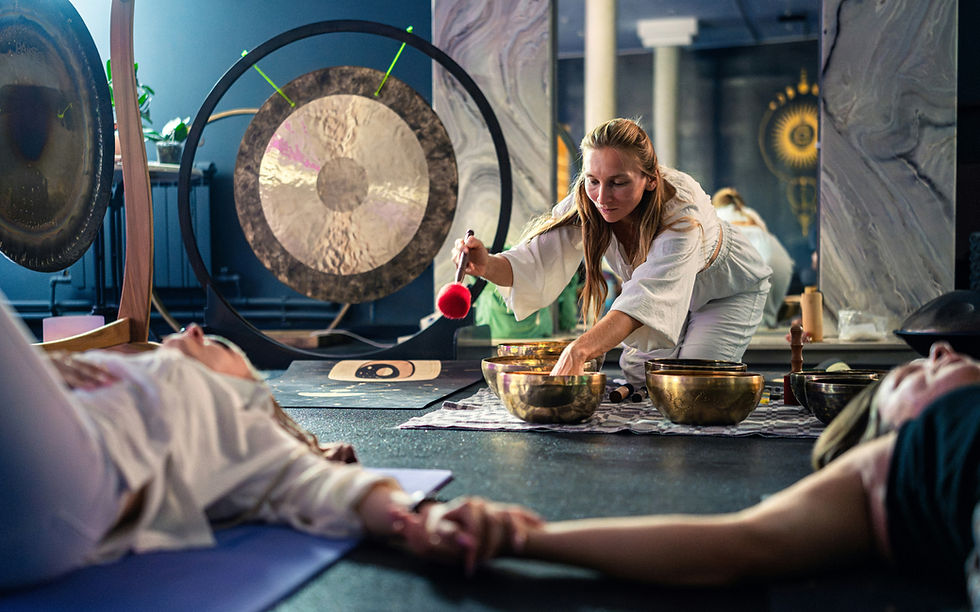
A sound bath is a meditative experience where participants are immersed in sound produced by instruments such as Tibetan singing bowls, crystal bowls, chimes, drums, gongs, rain sticks, ocean drums, tingsha bells and other calming instruments.
Despite the name, there is no water involved.
Instead, you are "bathed" in layers of sound while resting comfortably, usually lying down or seated.
The sounds provide a focal point for attention, much like the breath is often used in traditional meditation.
For many people, the sounds make meditation feel more accessible because there is something gentle to listen to rather than simply sitting in silence.
The sounds can help draw attention away from the constant stream of thoughts and into the present moment.
What Does a Sound Bath Feel Like?

This is a bit like asking, "What does a holiday feel like?"
The answer depends on the person.
Some common experiences people report include:
Feeling deeply relaxed
A sense of spaciousness or calm
Drifting between wakefulness and sleep
Increased awareness of thoughts
Emotional release
Visual imagery or vivid memories
Feeling refreshed afterwards
Feeling grounded and present
Gaining insights or new perspectives
It's important to remember that these experiences vary from person to person and even from session to session.
You may have a completely different experience each time you attend.
I've had participants tell me they felt incredibly relaxed during one session and quite emotional during another. Neither experience was better or worse. Both were simply what was present for them in that moment.
Is Relaxation the Goal?

Many people come to meditation hoping to relax, reduce stress, or feel recharged.
And often they do.
Relaxation is one of the most common benefits people associate with meditation and sound baths.
However, relaxation is not necessarily the primary goal.
Meditation is really about creating space.
When we create space, we give ourselves the opportunity to notice what is happening beneath the constant activity of everyday life.
Sometimes what arises is rest.
Sometimes it is insight.
Sometimes it is awareness of emotions that have been pushed aside.
Sometimes it is simply recognising how busy the mind has been.
Many of us move through life constantly doing, solving problems, caring for others, and moving from one task to the next. There is often very little time to simply be.
A sound bath creates an opportunity to pause.
Within that pause, the body may soften, the nervous system may settle, and the mind may begin to slow down.
For some people this happens quickly.
For others—especially those who are new to meditation or have particularly active minds—it may take time and regular practice.
Neither experience is wrong.
Why Do Some People Fall Asleep During a Sound Bath?

One of the most common things people worry about is falling asleep.
The good news is that it's completely normal.
In fact, many facilitators hear gentle snoring from participants from time to time.
The intention of a sound bath is not to put people to sleep. However, deep relaxation can sometimes lead to sleep.
Think about how many people use calming music, meditation recordings, nature sounds, or bedtime stories to help them wind down at night.
When we feel safe, supported, and able to let go of our responsibilities for a while, the body sometimes takes the opportunity to rest.
For some people, falling asleep may simply be a sign that they are tired and in need of restorative rest.
For others, they may drift between being awake and asleep throughout the session.
We'll explore this topic in more detail in an upcoming article:
Why Some People Fall Asleep During Sound Baths
What If My Mind Won't Slow Down?

Another common concern is:
"What if I spend the whole time thinking?"
The reality is that thinking is what minds do.
During meditation, people often notice thoughts about:
Work
Family
Relationships
Future plans
Shopping lists
Recent conversations
Things they forgot to do
This is completely normal.
Sometimes people assume that a successful meditation means having no thoughts.
In reality, meditation is often about noticing when the mind has wandered and gently bringing attention back to the present moment.
The sounds can be particularly helpful because they provide an anchor for awareness.
Listening to the changing tones and vibrations gives the mind something to return to whenever it wanders.
We'll explore this further in an upcoming article:
Tips for Staying Present During a Sound Bath Session
Can Emotions Arise During a Sound Bath?

Yes, sometimes they can.
Many of us spend much of our lives staying busy.
Activity can become a way of avoiding difficult emotions, uncomfortable truths, or experiences that we haven't fully processed.
When we slow down, those things may occasionally come into awareness.
This does not happen for everyone, but it is a common experience.
Some people may notice sadness, grief, gratitude, joy, relief, or compassion arising.
Others may simply feel emotional without fully understanding why.
This can be a natural part of giving ourselves time and space to listen more deeply.
The sounds themselves can sometimes support this process.
Just as a piece of music can bring back memories or evoke emotion, the sounds used in a sound bath can touch different parts of our experience.
When emotions arise, the invitation is not to force them away or analyse them immediately.
Instead, we can simply notice them with curiosity, kindness, and compassion.
Is There a Right or Wrong Way to Experience a Sound Bath?
Not really.
Some people remain alert throughout the entire session.
Some drift in and out of sleep.
Some feel deeply relaxed.
Some feel emotional.
Some gain insights.
Some simply enjoy having uninterrupted time to rest.
The experience you have may be exactly the experience you need in that moment.
A useful question isn't:
"What am I supposed to feel?"
But rather:
"What am I noticing right now?"
Approaching the experience with curiosity rather than expectation often creates a more meaningful and enjoyable experience.
Free Grounding Meditation
If you'd like a simple way to begin cultivating presence and calm in everyday life, download my free Grounding Meditation.
This short guided practice can help you reconnect with the present moment whenever life feels busy, overwhelming, or stressful.
Experience a Sound Bath in Sydney
If you're curious about sound baths and would like to experience one for yourself, I'd love to welcome you to my Monthly Mindful Movement and Sound Bath Meditation session in Castle Hill.
The session includes gentle mindful movement incorporating Tai Chi followed by a deeply relaxing sound bath meditation experience.
When: Monthly Sundays Duration: 1.5 hours Investment: $50
Monthly Mindful Movement and Sound Bath Meditation

✨ Visit our website for the current timetable or contact us at info@theresaperrywellbeing.com for private, community or work classes.
Final THOUGHTS

In the article, "Are You Supposed to Fall Asleep During a Sound Bath? What to Expect" we explored what happens during a sound bath, why people sometimes fall asleep, and why there is no right or wrong way to experience the practice.
A sound bath is not about achieving a particular state or having a specific experience.
Some people relax deeply.
Some fall asleep.
Some gain insights.
Some become aware of emotions that have been waiting for space to be felt.
The practice is less about forcing an outcome and more about creating an opportunity to pause and listen.
Whatever arises—whether it is rest, reflection, clarity, emotion, or simply a moment of stillness—can be part of the experience.
In the coming weeks, I'll be exploring some of these topics in more depth, including:
Why Some People Fall Asleep During Sound Baths
Awake vs Asleep: Does Sleep Change Your Sound Bath Experience?
Tips for Staying Present During a Sound Bath Session
If you're in Sydney, I also offer private sound bath meditation experiences, mindfulness workshops, Tai Chi sessions, and wellbeing programs for community groups, workplaces, and private events.
To discuss a tailored experience for your group, contact info@theresaperrywellbeing.com
Other related articles


Comments